All times Central.
Saturday, 10:36 a.m.
Just heard.
Friday, 5:20 p.m.
All veteran married people know the feeling I am having whenever I come into contact with Trump voters, even those who are trying to be conciliatory. It’s the anxiety that comes from trying to control your fury and doubting your ability to do it much longer without poisoning your very nervous system. #anefforttounderstand #alsoanefforttonotruineverything
Friday, 5:12 p.m.
Just in, at Writing Boots, from activist Randall Terry:

I called the number to report the typo. “You’ve reached the Terry Train, leave a message.”
Friday, 1:10 p.m.
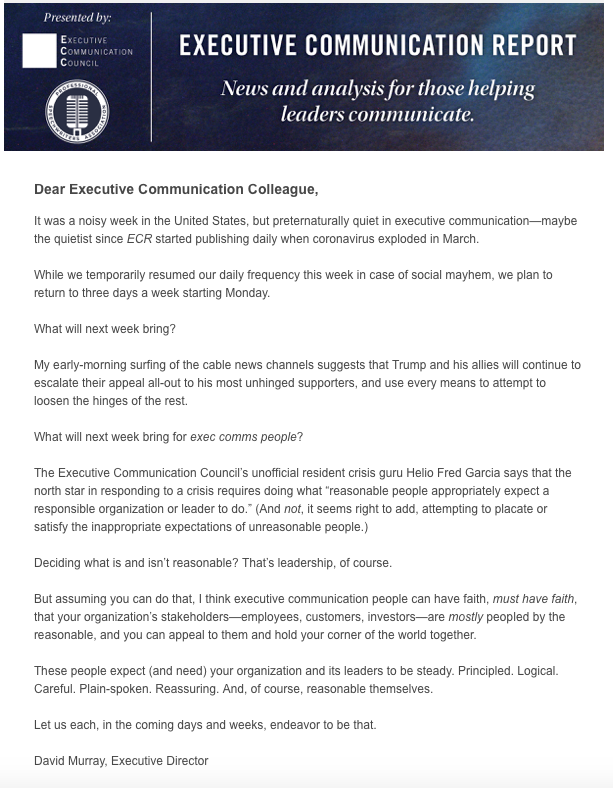
Issued this this morning, to about a thousand readers. Somewhat to my surprise, I have yet to receive a single reply.
Friday, 7:46 a.m.
The question I’ve started asking the corporate communication pros I’ve been talking to this week is, “What’s going on at your company? What’s on your mind? And do those two things have anything to do with each other?”
“Not much,” comes the standard rueful laugh.
I quoted my mother’s diary of depression early in this Election Week live blog. Might as well quote it again; a passage about her shrink.
R. says he’s been depressed lately, too. “Last Thursday, I just didn’t give a shit. I closed the office and went home.”
Friday, 7:45 a.m.
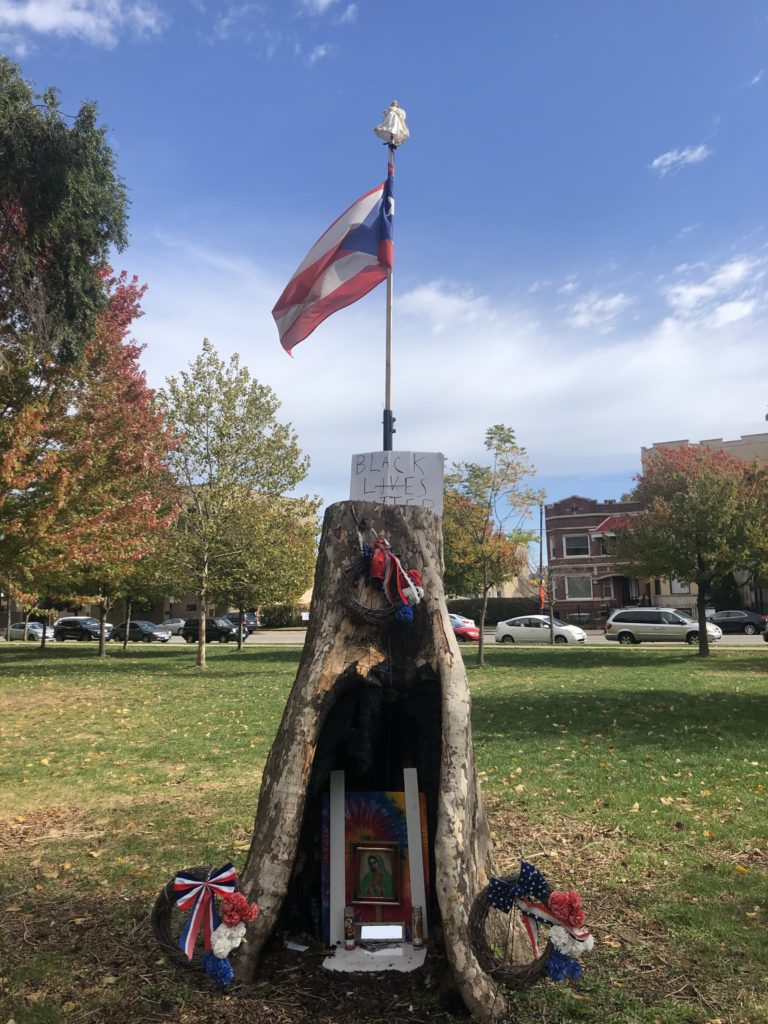
Humboldt Park, Chicago, USA
Thursday, 2:30 p.m.
A high school chum, on Facebook:
This country is so divided. What can we do? I am vowing to say the Pledge of Allegiance every morning like we did back in elementary school. Start my day off in my own little way to help unify the country and boost patriotism. It starts with you. Be the light to those around you.
Thursday, 9:48 a.m.
The dumbest form of virtue-signaling also might be the most common. It begins with, “I will never understand …”
It continues with “how anyone could vote for,” or “how someone could be so,” or “how anyone could fall for.”
And it concludes with a person or an idea that you sincerely find despicable.
When you say this, you are claiming as a celestial character trait your incurious inability to comprehend the alternative worldview of one person, five people, or seventy million fellow Americans.
It’s one thing to be mystified by our fellow human beings.
It’s another to boast about your ignorance in a tone that implies:
You are simply too good and pure to comprehend all these filthy souls. The world was never meant for one as beautiful as you!
As the PSA’s plain-talking writing coach Mike Long would say, “Stop that.”
Wednesday, 8:25 a.m.
The mind does what it wants to do, especially when it’s been medicated by three bourbons, a beer, a vodka lemonade and a tub of Cherry Garcia.
Late last night I found myself wanting to lash out at under-employed fellow Democrats who have smugly mansplained to me and to anyone else who would listen that we had nothing to worry about, essentially “because I read stuff.”
One of these people even issued a mock press release last week announcing his decision, and quoting himself. “‘It’s all over as of today,’ a confident and ebullient M—— said on Tuesday morning. ‘Everyone who knows me knows I am constantly predicting the end of the world — but not today. Biden is going to win and he’s going to win big.'”
What was the purpose of that? I wondered that at the time. Especially when I received an email about it from a suburban Republican friend, who had heard about it from another suburban Republican. “I guess you win,” he seethed.
As we agonize about little things that might have depressed Trump turnout in a tight election, I think we should consider: “Democrats not acting like cocky fuckheads” over the course of the last few days, weeks, months and years. We know revenge against arrogant liberal arts types is one motive for voting for Trump. And lots of arrogant, incurious liberal arts types spent the last four years recklessly inciting more of it.
But this morning, as Trump’s victory doesn’t seem inevitable but the sadness remains—”after great pain, a formal feeling comes”—I find myself thinking about that suburban Republican friend. Who I love. Who loves me (and texted me so in the middle of it all last night). Who loves people in general, when they are in front of him, who helps them when he has a chance to help them, like almost no one I know. And who voted for Trump.
I want to talk to him. Not about everything. How about, just: Isn’t he at least upset that Trump has called for the stopping of vote counting?
I don’t want to talk to him. “An effort to understand” doesn’t mean “a soul-searching interview with every Trump voter not wearing a white hood.”
I want only to say how I feel. And I’m finding that other connections are doing a better job of laying their tongue to it, on social media.
“I’m finding that while I love this country, I have no faith in it,” says a high school chum whose soul I’ve admired for about 40 years.
“I feel so strongly that the American elections should be about decency—about the decent people I know there and not about money or power or influence or charisma or greed,” says a friend who lives in France. “But they are not. Primarily they are about greed. Well, you get what you deserve.”
“I try to be empathetic to opposing sides and understand the motivations,” says a friend of a friend, “but I simply can’t grasp how anyone who cares about this country could blindly accept another four years of this chaos. No matter how this swings, I fear it’s going to take multiple generations before our society can heal and learn from our mistakes.”
Generations, indeed.
Generations ago, Abraham Lincoln said in his first inaugural, “We are not enemies, but friends. We must not be enemies. Though passion may have strained, it must not break our bonds of affection. The mystic chords of memory will swell when again touched, as surely they will be, by the better angels of our nature.”
On the verge of a Civil War that commenced a month later, that must have seemed like wishful thinking then, too.
Onward today, step by step: As hopefully as we can manage, as honestly as we dare, as lovingly as we can—as sad and angry and morally disoriented as we are.
Tuesday, 5:38 p.m.
Speaking of Tombs, my home is a humorless one now, and getting more so by the minute. We aren’t watching geeky-Election Day clappy-hands Rachel Maddow tonight. We aren’t even watching Wolf Blitzer. We are watching PBS. Even if PBS is only playing Masterpiece Theater.
Tuesday, 2:06 p.m.
When I was going to live-blog tonight, I found two alternative musical performances to cap the night. I’m going to hold the one for if things go decidedly well. But here’s the one I was going to post in case of a clear defeat.
Tuesday, 11:25 a.m.
Every corporate CEO, nonprofit director and university president has two or three statements laid out for tomorrow, depending on the results or non-results tonight.
Do you think there is a civilized concession speech in a speechwriter’s Word doc somewhere in the West Wing?
I wonder.
Because, first of all, President Trump has as much as promised his supporters he will fight the presidential election results with the ferocity and sportsmanship of a rabid wolverine.
Also? Trump has an ethical problem with concession speeches in general.
As I reported here on Election Day 2016, Forbes had spoken with Donald Trump that April about his attitude toward concession speeches. He wasn’t a big fan. “They fight like hell for six months, and they’re saying horrible things, the worst things you can imagine,” Trump said. “And then one of them loses, one of them wins. And the one who loses says, ‘I just want to congratulate my opponent. He is a brilliant man, he’ll be a great governor or president or whatever.'”
In other words, concession speeches strike Trump as insincere.
He continued, according to Forbes: “I’m not sure you’re ever going to see me there. I don’t think I’m going to lose, but if I do, I don’t think you’re ever going to see me again, folks. I think I’ll go to Turnberry and play golf or something.”
Tuesday, 7:15 a.m.
Writing Boots readers will recognize a familiar phrase in this headline, as the standing rubric used here for a rolling live-blog that took us nonstop through the first 13 weeks of coronavirus—basically, from the beginnings of the lockdown, when we all felt like we had been “hit on the head by a cow,” to George Floyd, when our feeling seemed to defy my poor power to add or detract.
I have booze-blogged Election Nights in the past, because it was fun. This year, if I’m drinking, I won’t be bragging about it; in fact, I won’t actually be blogging during the returns tonight, either. (I think I should be with my family for this, rather than with you.)
But I will be live-blogging today and the rest of the week about Election Day, for the same reason I live-blogged the first three months of coronavirus: something to do with my hands.
This popped up on my computer yesterday morning:
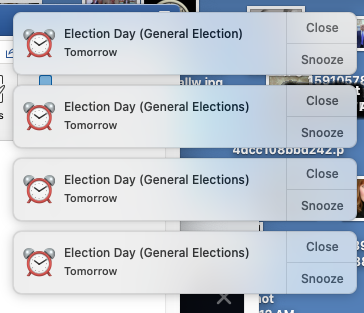
As my mother once wrote in a journal about manic depression, “Alarm goes off in morning like firing squad.”
That feeling evoked, by an Election Day.
***
I was a twenty-three-year-old editorial assistant at a Chicago publishing company in 1992 when one of the older editors walked into the office one Wednesday morning in November.
“How’s it going?” I asked him.
“Great!” he said. “For the first time in twelve years!”
“Huh?”
“Ummm, the election last night?”
“Oh, right, yeah, Clinton! Congratulations.”
Honestly, I felt a little sorry for a guy whose inner life was affected one way or another by something as distant and impersonal as a presidential election. But then, what did I expect? I figured I’d probably be taking stimulation where I could get it, too, when I got to be his age. (He was about 32.)
I was 31 in 2000, when my wife and I went to bed at midnight and left my nephew Danny, who was living with us at the time, to watch the late returns.
After a full eight hours of sleep, we got up Wednesday morning and found Danny still sitting in the same armchair, a full ashtray balanced on one of the arms.
“They haven’t called Florida,” he gurgled.
I experienced my first bitter election when I was thirty-five, in 2004. That night, a ticket that we all thought was the height of stupidity and evil and recklessness soundly beat a ticket that represented what we thought was the soul of intelligence and decency and boringness. I remember the next day, contemplating aloud some kind of anarchistic protest to an equally upset but much older friend. And I remember him telling me politely that I needed to simmer down.
I got all my work done by noon on Election Day 2008. On that brilliantly sunny fall afternoon, I drove down to Joe Louis golf course on the South Side and got grouped in a foursome with three strangers, all of them Black. We hit it off and talked happy trash, for 18 holes, without ever once mentioning the Obama victory that was about to usher in a post-racial nation. I was thirty-nine then—and my daughter was four. That year her Montessori preschool choir ended “Rudolph the Red-Nosed Reindeer,” with, “… you’ll go down in history—like Obama!”
Election Night 2012 wasn’t too memorable, then Election Night 2016 was too memorable. As memorable as a childhood accident.
And now I am fifty-one—and my daughter will be 17 this month. She’s working as an election judge today, 5:00 a.m. to 7:00 p.m. Then home to watch the returns.
I’m terribly distracted today, writing badly, indecisive, needing to do some event planning and doubting my ability to focus on it. Maybe the thing is not to spend the day guessing what might happen in this country, but to quietly, fully let sink in what already has.
Emily Dickinson wrote that, “after great pain, a formal feeling comes—The Nerves sit ceremonious, like Tombs … This is the Hour of Lead—Remembered, if outlived, As Freezing persons, recollect the Snow—First—Chill—then Stupor—then the letting go—”
Then, whatever tonight’s outcome (if outlived), back into action on Wednesday—for my family, my friends, my readers, my customers and my country.