Today a group called Speechwriters of Color announces its formation.
Is this truly necessary?
I think it is—but I understand why some would ask the question.
The Professional Speechwriters Association, like the profession it represents, is about 95% white.
The Professional Speechwriters Association is only a little bigger than the Lighthouse Keepers Association, which I imagine is also pretty doggone white.
In the scheme of things, how much does diversity really matter, in a tiny industry like this?
I’ve traveled a ways to answer that question for myself, and I thought I’d tell you about that journey, by way of telling you why the PSA is also enthusiastically supporting Speechwriters of Color, “an organization dedicated to advocating for writers of color, amplifying their voices, and promoting representation and professional development in the speechwriting industry.”
Now, I would not have disagreed with that mission 15 years ago, when I interviewed the first Black White House speechwriter, Terry Edmonds, who was chief speechwriter in the Clinton White House. Back then, Edmonds told me how he agonized over whether to help Clinton with the speech announcing the welfare reform bill Edmonds despised. And how he decided to write the speech after all, because he thought he could write it more thoughtfully than any one else.
I surely would have appreciated the Speechwriters of Color mission four years ago, when I brought Edmonds, and rising-star speechwriter Larae Booker together to talk on the subject at the 2016 PSA World Conference. We got to the end of that session, and we realized we didn’t know where to begin to diversify speechwriting—only that we wanted to. (It also emerged during that session that Edmonds was not only the first Black speechwriter in the White House—but also, so far, the last!)
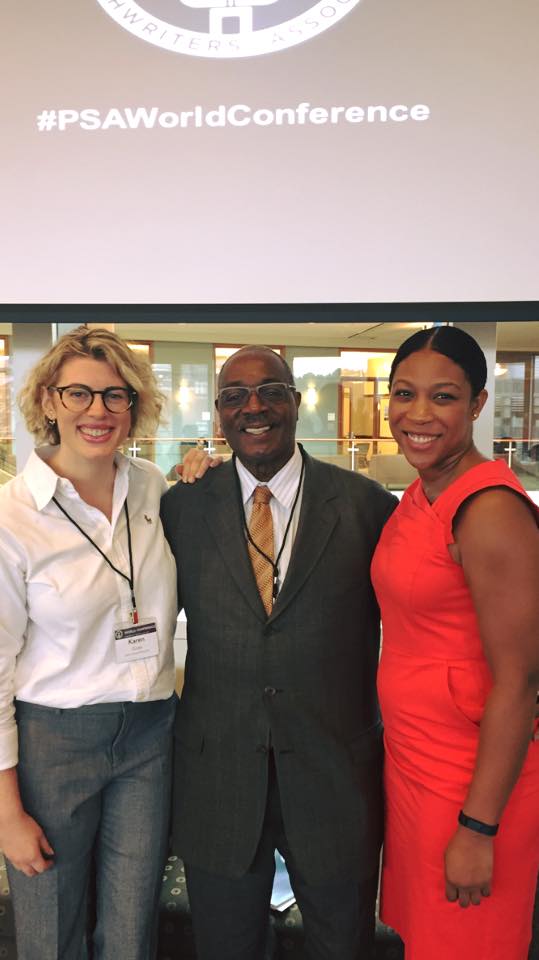
And of course I would have agreed with the Speechwriters of Color mission as I sat in the audience last fall, at an event the PSA also supported, the first Black Speechwriters Symposium, at Howard University. Organized by an astonishingly resourceful, determined and thoughtful Howard legal comms undergrad named Michael Franklin and attended by then West Wing Writers speechwriter Mintaro Oba, this event was probably the spiritual inception of Speechwriters of Color.
Just as I and the PSA have supported speechwriters of color for many years, we would have supported their formation into a formal group, just as a matter of course.
But only recently did I begin to see that that we actually—that I actually—need Speechwriters of Color.
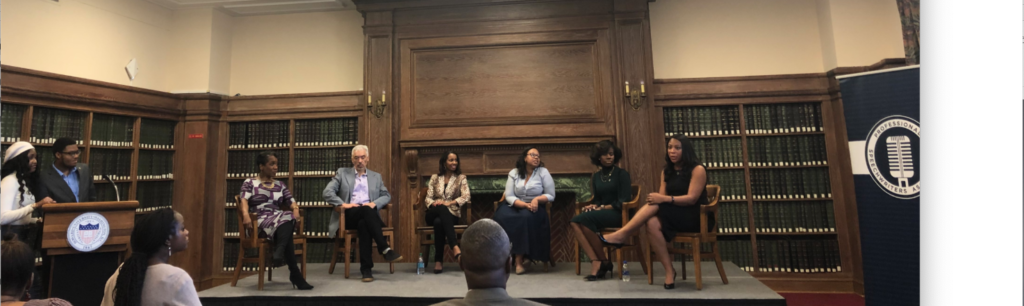
That groggy awakening began after that Howard event, when I wrote an account of the Symposium and ran it a past panel participant, UPS speechwriter Janet Stovall (seated left, above). Janet told me that the meeting was Black people talking to Black people, and that by reporting some of its most candid talk and publishing it for an audience of largely white people whose ears weren’t ready to hear such truths—I would be endangering the livelihoods of the Black people I was quoting.
Well, the hell if I was going to do that. I told her I’d spike the piece immediately.
Janet told me to write a different story—about my own race journey, what how it felt for me to be in that room listening to Black speechwriters tell their experience. I told her that what I’d heard hadn’t really surprised me much, and the experience of being there hadn’t quite rocked my world.
What kind of white bread fool did Janet Stovall think I was?
Yes, I grew up in an Ohio suburb called Hudson. Though it had been a stop on the Underground Railroad and was a childhood home to abolitionist John Brown, it was so white, I can not only count my high school’s Black population, I can name her: Angela Clark. Studying English at Kent State University didn’t teach me much more about race, beyond reading about William Faulkner’s Joe Christmas and Richard Wright’s Bigger Thomas. Then I moved to Richard Wright’s town, Chicago.
In 1992, I literally became a political being while riding the Lake Street El past the Henry Horner Homes housing projects while reading a book about a family living there, There Are No Children Here. Spike Lee’s Malcolm X came out right around then, too; I saw it in a movie theater with an all-black audience. All of these experiences made race in America to be the most important subject in the world.
In the later 1990s, my wife started teaching elementary school on Chicago’s West Side, and I got intimately acquainted—or as intimately acquainted as I could stand—with the horrific inequities in this country of ours, and what it does to kids (and what kids do back).
By then I’d aligned myself politically with socialist heroes like Studs Terkel. I fell honestly, and to a few of my friends, disgustingly, in love with Barack Obama. I wrote a history of black golf in Chicago for The New York Times. I took my daughter Scout to a South Side soul food restaurant for Black History Month.
I believed that if I brought all that experience and reading and writing and thought and love to bear, I could speak and write sensitively about Black people, to Black people—maybe even for Black people.
And you know what? I think a lot of white professional speechwriters and other communicators have long felt that way, too. Many come from journalism backgrounds, many are better-read than other corporate colleagues and whether they are personally conservative or liberal, they feel their liberal arts backgrounds make them open-minded enough.
But many of those communicators who I’ve talked to have had that self-confidence shaken or shattered by George Floyd, and the aftermath. They’ve been enlightened, either by the benefit of consulting Black colleagues inside and outside the communication department, or by the consequences of not receiving such counsel. I know a busy crisis communication consultant who says most of his clients are communicators who mishandled George Floyd, and are still trying to dig their way out, four months later.
I think most communicators now sense that institutions and their leaders can’t communicate effectively with Black people and other people of color on issues like diversity and inclusion and social justice without the help and insight and perspective of Black people and other people of color.
Of course, not every executive communication operation at every corporation, university and nonprofit will have speechwriter of color. But every speechwriter should have easy, arm’s reach access to a smart, thoughtful colleague of color who can flag a tone-deaf line in a speech … or suggest the need to address an issue … or to explain an issue to the leader in a way to make the leader see another side.
And obviously, communicators of color—and would-be communicators of color—should have the encouragement of all their colleagues in getting their voices heard and their perspective understood—for the good of us all.
So the Professional Speechwriters Association—and its executive director—are thrilled to support Speechwriters of Color, not just to diversify speechwriting, but to lead the rest of the communication profession, also overwhelmingly white, in similar progress. If institutions are going to become more culturally sensitive, their communicators have to be more than well-intentioned. Rather than trying to walk in the other person’s shoes—how about let’s hire a communicator who walks in her own shoes, all the way to work?
Or in the words of Michael Franklin, Mintaro Oba, Janet Stovall and all the founding members and supporters of Speechwriters of Color:
As speechwriters, we have an incredible capacity to shape the narratives and advance the ideas that drive our country’s leaders. Take the signatories to this statement: we include past and present speechwriters for congressional leaders, Fortune 50 CEOs, non-profit organizations, leaders of international organizations, celebrities, even past Presidents of the United States.
With this power comes an obligation to help redress the injustices of the past and do our part to create a better, more inclusive, more equitable future.
Communication friends, I’m in. How about you? Sign here to declare your support.