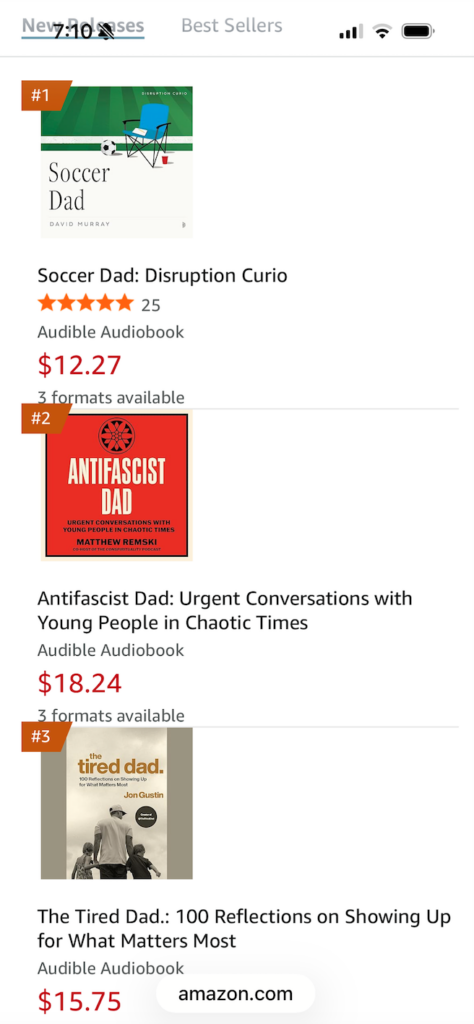
I was checking into the Ohio University Inn for my daughter’s college graduation earlier this month when I saw this lovely email.
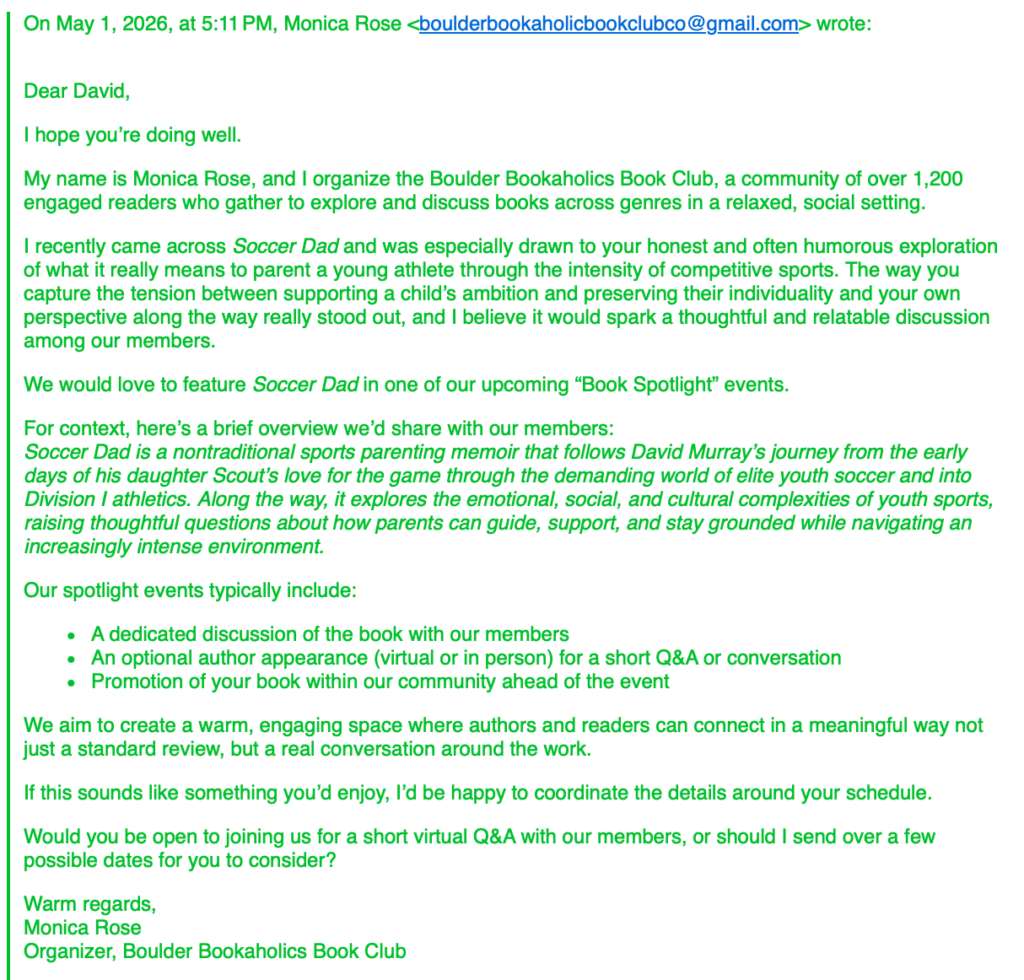
It had been a couple of weeks since the frenzy of the book’s launch, and with things quieting down, this was just the kind of invitation I’d been hoping to start getting.
When I returned to Chicago, I didn’t hide my delight at this invitation, telling Monica, “This is especially excellent seeing that I have a lot of family in and around Boulder, who will be interested. (Four sisters and their kin.)” I asked her for more details, so I could consider whether to appear via Zoom, or turn the event into a little family visit.
Promptly, I got 19 happy paragraphs back from Monica, each of them reading like this:
For an in-person gathering, we usually host in a relaxed, social venue here in Boulder often a cozy café, wine bar, or community space that allows for an intimate but lively discussion. Attendance typically ranges from 25 to 50 engaged members, depending on the book and timing. The atmosphere is warm, conversational, and highly reader-driven not a formal presentation, but a genuine exchange of ideas. If you were able to join us in person, we would shape the evening around a discussion first, followed by a natural, informal Q&A with you woven into the conversation.
Yummy in an author’s tummy! I replied, “Wow, Monica, you folks don’t mess around! Everything below sounds absolutely lovely and I look forward to committing to this with you one way or another.” I chose one of the dates she offered based on my availability and also its correlation with our Father’s Day promotions. And I proposed a call, later in the week.
Monica replied affirmatively, calling my Father’s Day angle “brilliant” and saying, “Friday sounds perfect for a call I’d love that. Feel free to suggest a time that works best within your open windows, and I’ll make myself available.”
To which I replied, “I’m really knocked out by the thoroughness and thoughtfulness of your approach here and excited to connect.”
Now folks, I’m already once bitten. While promoting my last book, I got pulled into a long and mind-bending dialogue with some huckster claiming to be the documentary maker Michael Moore, who I was hoping would push it to his followers.
With Soccer Dad, I’ve already been approached by a few opportunists whose advances my publisher helped me head off. Scamming authors is like panhandling the homeless: as morally low as financially dubious. But apparently it’s a thing.
Also recently, I was invited to participate in a kind of SEO scheme through some soccer parent website. Guy kept telling me to just post a ton of stuff there, no matter the quality: “it’s as if someone else is telling google that your book is valuable. nothing else really matters. you want as many links as possible. it doesn’t even matter (per say) if people read it …” I wound up telling this plastic-eyepatch alley-man, “I didn’t write a book so I could become a bot.”
So as much as I was looking forward to visiting Boulder virtually or in person, as much as I allowed myself to accept the kismet of a Boulder book group embracing my book—hey, it wouldn’t be the first lucky thing that happened in my life—the fuzzy feelings turned to suspicion right away and Monica became “Monica” as soon as “she” wrote back: “Friday at 10:00 works well for me. And if you don’t mind, I’d actually prefer to continue our conversation here by email rather than by phone. It helps me keep everything clearly organized and intentional as we shape the experience together. I’m very happy to move quickly back and forth so it still feels fluid and easy.”
One of my Boulder sisters and I quickly discovered: Monica Rose was an elusive presence online. And, others had asked about Boulder Bookaholics being a scam. I wrote, “Monica, pardon me but this is getting a little strange to me, and starting to seem a little commercial. You don’t wish to talk on the phone? Also, I can’t find you online anywhere.” I pasted in a post about the possible scam. “Monica,” I e-cried, “say it ain’t so!”
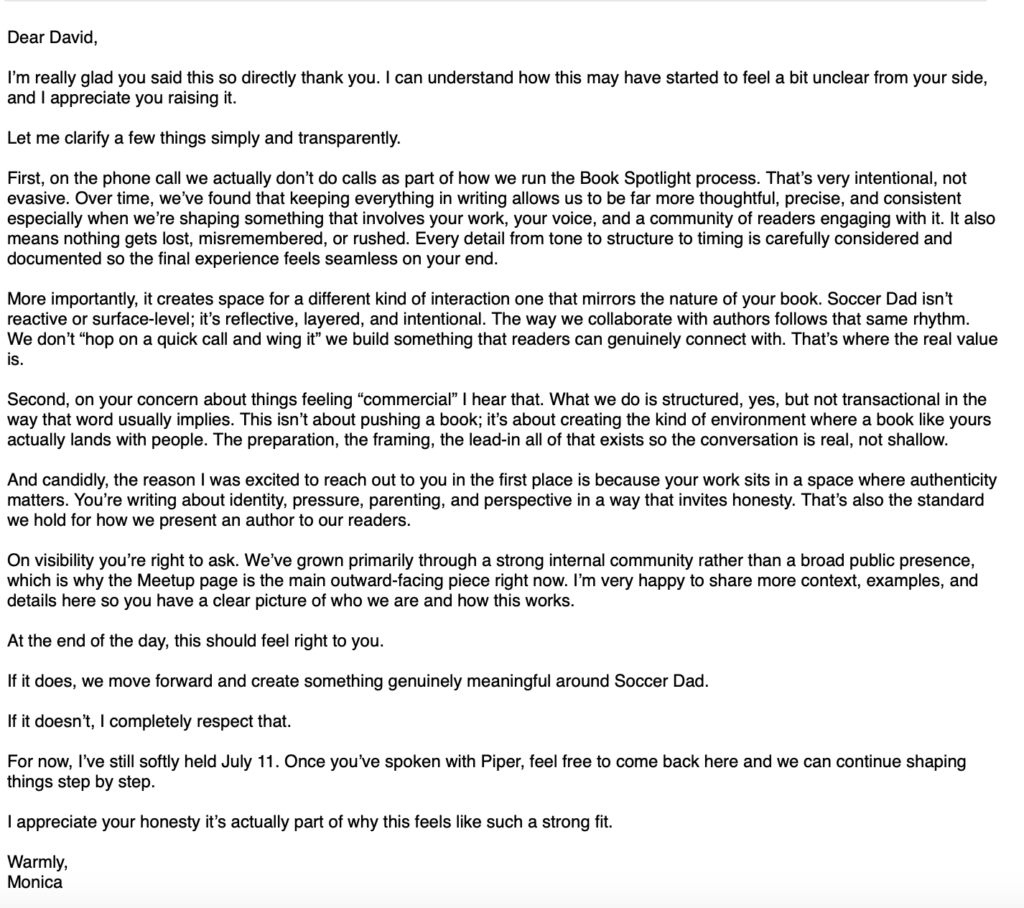
And that, as the say, was the end of that.
What’s the lesson here? If you try to do anything in this life, people will try to take advantage of your undisguised desire—even if it’s something as dopey as writing a book.
Especially if it’s something as dopey as writing a book.