Spoiler alert: This is best enjoyed and understood by the many who have read my new book Soccer Dad. For those who haven’t read it, I hope you’ll buy your copy—print or Kindle or Audible—and then return to this. —DM
***
My book Soccer Dad has received just the kind of reaction I’d hoped for: emotional responses from an overwhelming number of exactly the kinds of people I was hoping to reach: sports parents, in the thick of the experience. “Read it in one sitting, and I think it’ll be an annual read,” one soccer dad wrote me this month. “Loved it.”
Amid many such notes, I’ve received only one complaint:
Soccer Dad does leave readers hanging.
As it ends, they’ve just endured alongside Scout Murray and her parents an agonizing, epic junior soccer season—one that saw her get off to a promising start, then suffer a drop in confidence, then an injury and the humiliating loss of her starting position. The season ended on a slightly hopeful note—and Scout’s expression, texted from the team bus home, of grim determination to make something more of her senior season.
But readers of Soccer Dad don’t get to find out how that senior season turned out, and thus how Scout’s career ended. Instead, I write: “Whether she scores a ton of goals and Ohio University wins the conference, or her last season is the kind of struggle that most sports seasons turn out to be—that matters to her, and it matters to me and her mother. But it doesn’t matter to you. Scout’s mom and I have run our race, and you’ve got miles still ahead. We did the best we knew how to do, and so will you.”
But of course it did matter to many readers, who’d become attached to Scout and our family’s tale. Some of them have looked up her statistics, which only tell part of the story. Others have sent me direct messages on Instagram, aching for a satisfying conclusion.
I’m writing this postscript not just to sate a desire for resolution, but also because I think that, as it turned out, I was wrong when I said Scout’s mom and I had run our sports-parenting race by the time Scout’s junior year was finished.
No, there was one more leg to go—a hard one, and thus instructive, too, I hope.
***
During the spring off-season after her junior year, Scout worked hard to win back her coaches’ confidence, and her own. By the time she returned to Chicago, the grim determination was mine: To count and to cherish every last minute of her last college summer here. Fierce determination, was more like it. Ask a colleague who scored a potentially lucrative but days-long promotional trip in the Summer of Scout, and got an earful of anxious frustration from me. “I thought you’d be happy!” she said.
Scout, her mother and I did spend a lot of that summer together. There was a trip to see friends in Cleveland, for Father’s Day. Scout taught me how to play pickle ball. She was 21 now, so we occasionally went to the corner tavern and shot a game of pool.
But mostly, we sat on our back porch, talking about how Scout was preparing for the next season. And talking, and talking, and talking and talking.
She played in a summer league on a semi-pro team in Chicago called the Edgewater Castle. Those games were fun—and for player and parents alike, less emotionally vacuum-packed than Scout’s college games had become. And she was working out regularly—sometimes dragging the old man to the treadmills at Planet Fitness to put him through a light version of her arduous interval training.
So physically, she was ready to go.
Emotionally, it was more complicated.
By June, we found ourselves having the same conversation, over and over again:
How to gear up to have a dream season: scoring a lot of goals, winning a lot of games, winning the Mid-American Conference championship for the second time in her career and seeing how far the team could get into the NCAA playoffs. One must prepare for the possibility of greatness. One must be open to good fortune. One must be ready to spot an opening, and shoot the ball.
Meanwhile, however: What if this season went like last season? Or what if it just went like the vast majority of sports seasons do: waves of high hopes crashing into rocks of disappointments, and leaving behind pools of failure in the end? That probability had been more palatable in every one of Scout’s soccer years previous—because every one of those years, there was always next year. This year, no next year. How to prepare for that?
Our back porch conversations came to focus not on the results of her senior season—which we still fervently hoped would be great. (Just how fervently, you’ll learn in a moment.) But we talked more about the story she would tell, we would tell, about her soccer career—win or lose. We decided it wouldn’t be acceptable to any of us that the last 20 games of her soccer career, and her team’s four-year journey together—could be a joyless grind to a bitter end. No, she—they—had to find a way to enjoy this season, no matter what.
We decided the season didn’t need an orchestra-swelling Frank Capra conclusion in order to honor our family’s original, ultimate dream of soccer sisterhood: the one we’d conjured when Scout was a little girl, while watching a documentary about the relationships among the 1999 Women’s World Cup champs. The one we fixed our family’s sights on, as the “higher purpose” of our soccer journey. And the one that had come true after a miraculous MAC championship season, with Scout and her teammates exchanging tears of astonished gratitude and love for one another, around a dinner table in Chicago.
Once a dream has come true, it can’t come untrue, can it?
Most importantly, this season—and thus Scout’s whole career—had to end in a way that felt like a launching pad for the next phase of her life. It had to be the beginning of the story of the rest of her life. One season’s wins and losses couldn’t be depended upon to validate that story, nor be allowed to dampen it, we decided. Individual performances couldn’t, either.
So the grim determination now concerned the story we told ourselves, every bit as much as the soccer itself. While endeavoring to be part of a strong senior class that could lead a team to a great season—we would always keep that story straight, so no one ever forgot the larger purpose, as I describe in Soccer Dad: “No matter how serious youth sports becomes, and it becomes very serious indeed, the joy, the pride, the love is what must remain the highest purpose of all this—in fact, the only purpose, in the end.”
It was a tall order. Too tall, some days.
Like the early-August Saturday morning that Scout called in tears after a practice. She’d been back in Athens for pre-season training for about a week, and was feeling overlooked by the coaches, a reminder of last year’s agonies.
This triggered in me a kind of PTSD reaction, and I shocked Scout and my wife and myself—and a college friend who happened to be in town—by bursting into uncontrollable tears. So upset was I, that the call ended with Scout reassuring me, that things weren’t as bad as they seemed, and saying she and her coaches might just be having a bad day.
I was comforted by her confidence but shaken that just below all my declared mindfulness ran a hot, salty aquifer of emotional desperation that seemed, at times, to exceed my daughter’s. During the season, Scout would come to tease me about how much of my time she figured I spent thinking and worrying about her. Seventy percent, was her estimate. I called her a narcissist, and assured her it was only 35 percent.
In any case, over the course of that season, there was a lot to think and worry about:
An essential player—and one of Scout’s closest teammates—tore her ACL in pre-season: one awkward step on the practice field, and out for the year. And a key defender had a nagging hamstring problem that kept her out too.
Badly weakened but still determined, the team lost excruciating 0-1 early-season games to powerhouse schools Clemson, University of Pittsburgh and Indiana University. The closeness of those games might have given the team heart, but that’s not how it played out, and a subsequent series of conference losses began to turn the season into a slow mudslide.
Toward the end of a loss-by-loss diminishment of playoff hopes and the dawning of the realization of the inevitable end, the OU coaching staff were occasionally overwhelmed by the powerful emotions they felt for Scout and her teammates—the class that had led OU’s first-ever MAC championship, after all. In team meetings large and small, and sometimes through uncharacteristic tears of their own, the coaches repeatedly called these women a “special group” that had “changed this program forever.”
How to evaluate Scout’s performance through all this? She started in 14 out of the 19 games and played well in many of them, but scored only one goal all season, and had one assist. She played fiercely and heroically in an unforgettable game at Kent State, when thanks to a red card in the opening minutes, OU had to play a man down for the remainder of the game. The gut-griding 0-1 final score didn’t reveal the blind grit Scout and her teammates showed in keeping it that close—and very nearly tying the game in the end. “Honestly, that was one of the best five games of my whole career,” she told me later.
Alas.
Counting down the games, Scout’s mom and I took more trips than usual: There was an overnight at Indiana, and an eight-hour daytrip to Central Michigan. There was a sunny, boozy Senior Day weekend in Athens. With some Michigan-native family members, we traveled to Ypsilanti, to see OU play Eastern Michigan. I rode my motorcycle from Chicago on a frenzied four-day Northern Ohio swing that saw the Kent State heartbreaker and a disappointing tie at Toledo. That was a long ride back to Chicago, into the setting Sunday evening sun.
By the time we returned to Athens for our last home game there, the season was all over but the shouting, and a 3-0 win against Northern Illinois, in the company of more visiting family, was cold comfort in a steady rain. The next week, OU was officially eliminated from the MAC playoffs in a resounding 0-3 loss at Miami, in the penultimate game of the season.
It was a kind of blessing to be eliminated from the playoffs early: While many careers end in shocking, anticlimactic playoff losses, our players, and their parents, knew this would be the last game. It had been on our schedules for months: an away game, at the University of Massachusetts, in Amherst. Some of the parents made a tourist trip out of it. There was a big pre-game brunch. The trip was special for the players, too, as they flew to UMass. MAC teams usually ride buses, and this was their first time getting to be the Bobcat-swag-clad college jocks, in the airport.
Gameday was perfect: Sunny and cool and October all over. The game, against a good UMass team, was a surprising 4-1 walkover—a happy victory the likes of which this team hadn’t had in months. The seniors played the whole game, many of the offensive players scoring—everybody but Scout, who missed a comical number of shots in what would have seemed like a tragedy a week previous, but felt like the folly of life today.
I had stared at many scoreboards, as a soccer dad, wishing the time would wind down to preserve a victory. Now I stared, wishing time would stop. And then it was over and the players were all in each other’s arms in the middle of the field. And then the parents were taking pictures as we’d been doing after games since our kids were four years old. And then our daughters walked off to the bus, for the airport.
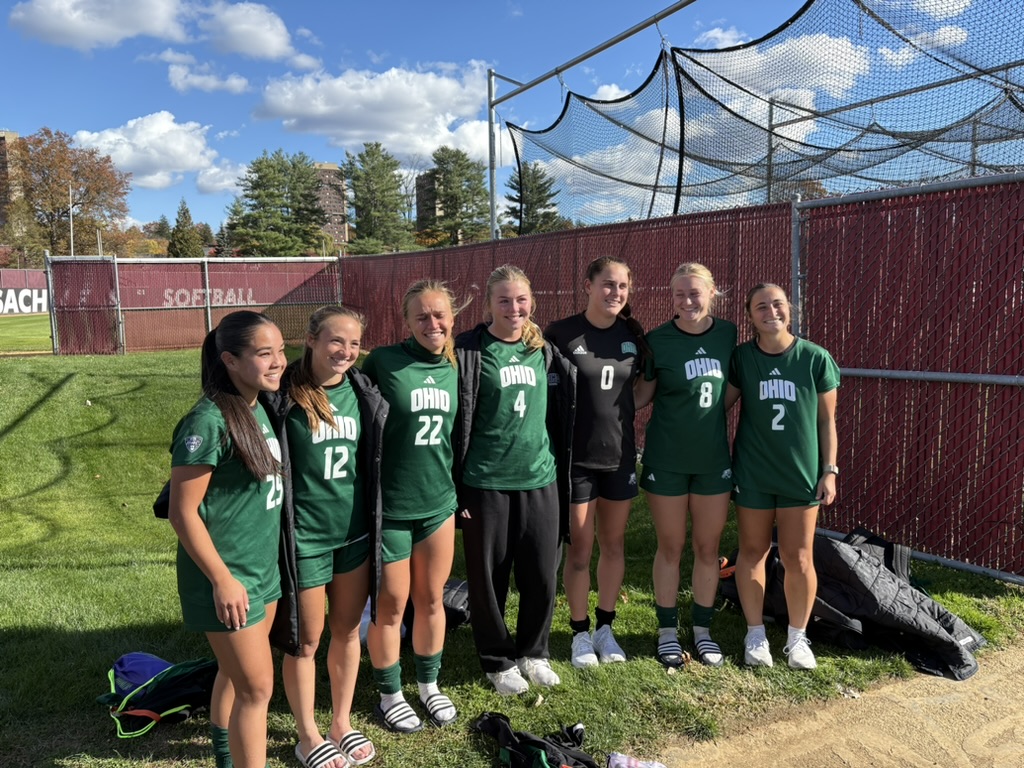
Which reminded instantly me of an old story, that I inadvisedly tried to tell to one of the few dry-eyed families (whose daughter had a year of eligibility left). “Oh God, Dave’s crying,” I heard my wife say, walking away.
When Scout was seven or eight, I put her on an airplane in Chicago, to visit family in Colorado. It was her first solo trip, and I’d been preparing her for days and hours, reassuring her that the flight attendants would handle anything she needed and Aunt Cindy would meet her at the gate in Denver and everything would be okay.
At the gate at O’Hare, I met the flight attendant who was going to take Scout onto the plane. I went to give Scout a last hug goodbye but the flight attendant was in a hurry and before I knew it my only child was walking down that jetway with confidence and determination, and not looking back.
Everyone sitting at the gate watched all this play out—and then they saw me cover my face as my mind suddenly fast-forwarded years and years—to when? to when? to when?—well, I guess it was to this very moment in Amherst, Massachusetts, my baby going off again, no baby anymore.
And this time, with sisters.
Leave a Reply