I’m quoted in an excellent article on the lifestyle website Inside Hook, “The ‘Agony’ or ChatGPT: Would You Let AI Write Your Wedding Speech?”
After acknowledging that AI has uses in the speechwriting process—the Professional Speechwriters Association that I head teaches these uses—I said there is no shortcut to writing a speech at a wedding.
“They wanted me, because I’m the brother-in-law, to give the speech,” Murray says, referencing a wedding address he once gave. “They want me to sit there and think hard about the people I’m about to say something about. They want me to think hard about the audience.”
“The more a human being really agonizes and thinks about that without the help of something spitting shit out at them,” the better, he says. “The more agony goes in, the more beauty comes out.” …
“To me, it’s sacred to be asked by a community [to give a speech like this], whether it’s a eulogy or a wedding toast,” he says. “If you’ve been asked by a person to speak in front of the community that they belong to at an important moment in their life and say something meaningful—Christ, that is worth your agony and worth your time.”
A longtime speechwriter friend read that to mean I would actually prefer a meandering, awkward wedding speech over a well-structured, nicely polished ChatGPT-polished nuptial oration.
He read it right. Yes, I would. With the exception of a bridesmaid’s speech that ran so long that I went to the bathroom during it, twice—yes, I actually love to hear people try, however well or clumsily, to express their love for one or two members of a community, before the rest of that community. It’s actually the closest thing to church that I ever get to experience. (And at a funeral, it’s the only thing about church that I like.)
I don’t think it’s important that such a speech be well-structured, I don’t think it needs to be well-rehearsed (heartfelt words land beautifully when read straight off a piece of paper, almost preferably held by shaking hands). I don’t even think it has to be smoothly delivered. Here’s me, during a brief break in my remarks at the wedding of my friends Steve and Cindy Crescenzo, whose bottomless glass of champaign created a mysterious gravitational pull between their wedding speaker and the wedding cake.
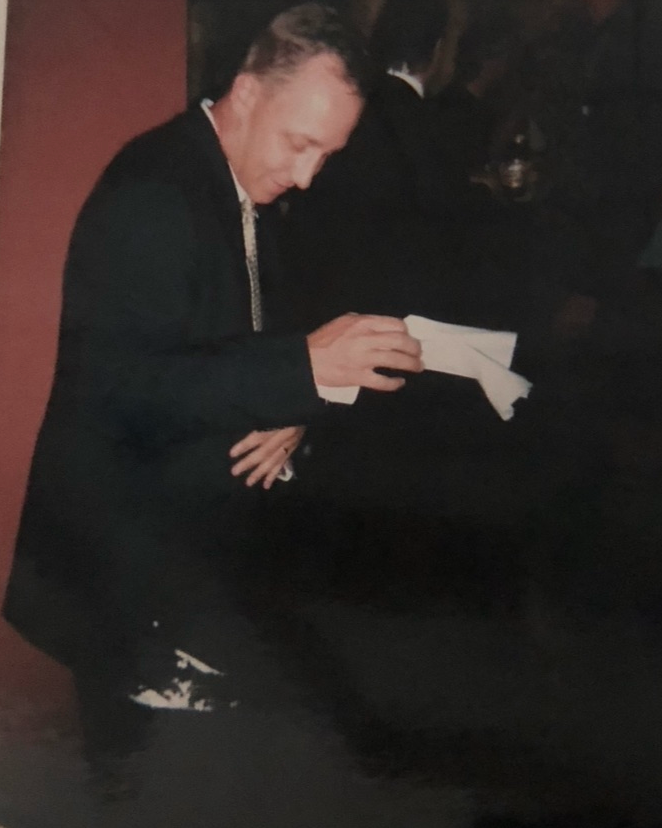
All a wedding speaker has to do is say a thing or two (or tell a story or two) about the honored community members that everyone in the audience understands is both beautiful and true. But of course, that’s the rub—every wedding speaker must. And sorry, Bub, ChatGPT can’t help you there any more than it can pat the frosting back onto the cake.
I’m glad there are speechwriters, for leaders who can afford their help for big speeches at important events. I’m glad there are quotation books and helpful websites and seminars from the Professional Speechwriters Association to help make people into more thoughtful speakers. And I’m glad there’s ChatGPT, for Walmart managers who are trying to figure out how to rally the troops at the Monday staff meeting in late February.
But some speeches are sacred, and their composition must be essentially human if they are to do their job, of bonding people together in love. Earlier this year, Chicago Pope Leo XIV advised clergy members to not use AI when writing homilies. “To give a true homily is to share faith,” he said, adding, “AI will never be able to share faith.” He warned: “Like all the muscles in the body, if we do not use them…they die. The brain needs to be used.”
The soul, too.
Leave a Reply